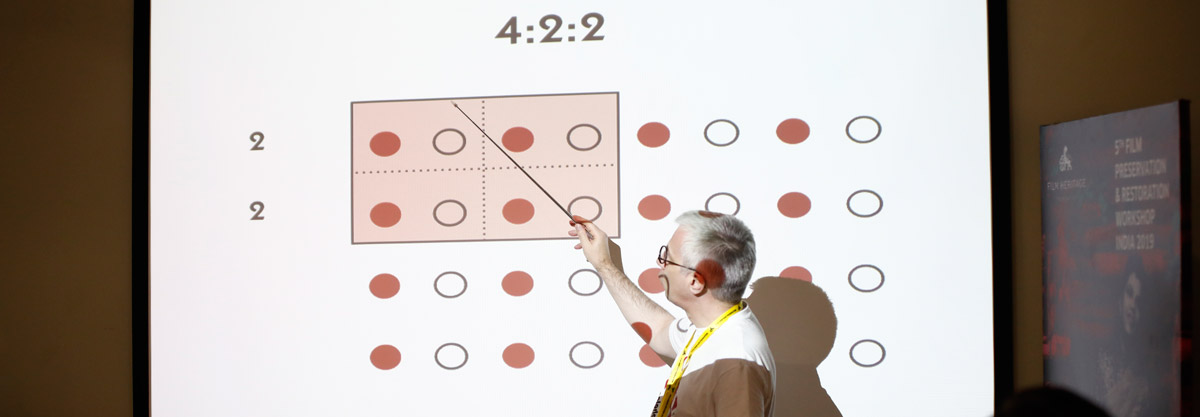
 Reto Kromer teaching. Photo courtesy of the Film Heritage Foundation
FIAF Commissions’ Thursday Online Workshops
In September 2022, the FIAF Commissions launched a new series of online workshops covering a wide range of topics discussed in FIAF. The basic idea is rooted in what libraries have done for some time now and which is called Library Carpentry. Rather than inviting external experts, trained people from libraries teach each other basic concepts which will also revolve around data literacy (introductions to Open Refine, Python, GitHub etc.). We could expand that format and think of other ones to accompany this very technical focus.
We also want to address current debates revolving around sustainability, long term archiving and online presentation. How can we digitize, archive and present digital media by taking questions of rights, formats and the environment into consideration?
The workshops are planned as virtual events for the moment and might later be extended to in-person events.
Possible formats include presentations plus a panel discussion and hands-on teaching. More can be developed as we gain experience. We don’t aim at experts. Usually, no previous experience is required. Advanced levels are marked as such and will provide knowledge for those who want to explore topics into more depths. The number of participants vary depending on the nature of the specific workshop, but is generally be limited to enhance knowledge transfer and discussion. No fee is charged, but participants have to register and places are limited. Information on how and when to register will be posted below.
Forthcoming Thursday Online Workshops:
15 October 2026
“AI in Digital Image Restoration - Ethics and Didactics“
Duration: 1.5 hrs, incl. Q&A
Organized/presented by: Anne Gant (Head of the TC, moderator); Ulrich Ruedel (HTW – University of Applied Sciences, Berlin); Franziska Heller (Martin Luther University, Halle-Wittenberg), Sreya Chatterjee (HTW – University of Applied Sciences, Berlin)
Limited to 35 participants.
Target group: Film preservationists, archivists, restorers and students.
Content: Novel AI tools for digital manipulation (“restoration”, colourization, interpolation, upscaling, etc.) of historical (moving) images—such as used in the well-known experimental colourizations and 60p upscales by YouTuber Denis Shiryaev—are already distorting historical audiovisual documents, especially when the moving images thus obtained proliferate online in an entirely uncontrolled and uncontextualized fashion. But even in professional film restoration, problematic use of state-of-the-art digital tools—not necessarily employing AI at all—is evident at times. This has previously prompted FIAF to publish the Digital Statement III (2021) as a restoration-ethical framework for digital image manipulation to ensure their historic and artistic integrity. At the same time however, the consumption and proliferation of such manipulated images are shifting society’s framework for evaluating them. In this presentation, we focus on sharing results from a teaching project, supported by HTW’s “Lehrinnovationsfonds“ (teaching innovation funds), to convey a critical, audiovisual-literate approach to film preservation students (and in the future, quite possibly beyond) and will give an introduction to our Shiryaev Memorandum, which furthers the philosophy evident in the DSIII from approaches ranging from classical and modern audiovisual restoration into the age of AI, by critically engaging with established restoration ethics as much as its popular, social media harboured cousins.
Registrations are now closed. Selected participants will be notified by email by 12 October.
“The FIAF Knowledge Graph - a Linked Data Project in the Making”
Duration: 1.5 hrs
Organized/presented by: Adelheid Heftberger (Host, Head of the CDC), Paul Duchesne (CDC member, National Film and Sound Archive, Canberra)
Limited to 20 participants.
Target group: Everyone interested in aggregating and mapping data, knowledge graphs, and ontologies. No expertise needed, but some basic understanding of metadata schemas, ontologies, semantic web will be beneficial.
Content: Paul will present the FIAF Knowledge Graph and its potential use for film archives. He will talk about the origins of the project, the challenges, the data management, and we will together look at search options. Anyone who wants to bring their own query examples or possible use cases is more than welcome!
Registrations for this workshop will open in early November.
3 December 2026
"Presenting the FAR Project and Discussing its Future"
Duration: 1.5 hrs
Organized/presented by: Florian Wrobel and Caroline Fournier (FIAF Technical Commission), and Camille Blot-Wellens (former TC member).
Limited to 25 participants.
Target group: Everyone working within a film archive or in the field of film preservation. In particular, colleagues from new archives or archives with small resources or lacking specific workflows.
Content: The Fundamental Archiving Resources project is a tool that brings together documents, methods, and resources that can be used by a wide network of archives, in order to provide the basics of collections management, as well as low-budget tools and principles for starting to work with a collection from scratch.
Following a brief presentation of the tool (15 mins), the workshop will focus on user feedback and a discussion about needs. A call for contributions will allow participants to suggest new additions or corrections, as this tool is a work in progress and needs to evolve in line with expectations of the community.
Participants will therefore be expected to familiarize themselves with the tool before the workshop so that they can provide feedback and suggestions.
Registrations will be open between 12 and 23 November. Selected participants will be notified by email by 26 November.
Past workshops:
7 March 2024
“CEN 15907 in practice: Using the Variant in the Centre national du cinéma et de l'image animée (CNC)”
Duration: 2 hrs
Organized/presented by: Adelheid Heftberger (Host, Head of the CDC), Katerina Kampoli (Film Cataloger, CNC), and Tristan Gomez (Database Administrator, CNC).
Limited to 20 participants.
Target group: Everyone interested in cataloguing using the CEN 15907 and particularly in understanding how to implement the Variant. This workshop will be most beneficial to experienced catalogers/information specialists but might be interesting also to those with an interest in the topic.
Content: The presenters will explain the way the CNC has implemented and adapted the CEN 15907 in “Garance” the institution’s new cataloguing tool. Then, the focus will shift on cataloguing in a 4-tier level using the optional variant level, illustrated by many examples. After the presentation the participants will address questions, share their thoughts and discuss the examples given beforehand.
Note that this event has now taken place.
Presentation slides of this workshop are available HERE.
23 May 2024
"Introducción a los metadatos para la descripción central de recursos de imágenes en movimiento: aplicaciones según FRBR, RDA, EN15907" (en español)
Duración: 3 horas
Organiza/presenta: Adelheid Heftberger (Anfitriona, Directora del CDC), Circe Itzel Sánchez González (miembro FIAF CDC, UNAM, Ciudad de México)
Limitado a 20 participantes.
Dirigido a: personas interesadas en la catalogación de recursos de imágenes en movimiento que deseen actualizar sus conocimientos sobre su descripción normalizada a nivel internacional.
Contenido: La ponente ofrecerá una introducción a las normas descritas a través de la explicación de sus conceptos básicos. Se presentarán ejemplos ilustrativos considerando distintos tipos de recursos de imágenes en movimiento. Al finalizar la presentación se atenderán las preguntas de los participantes.
Note that this event has now taken place.
13 June 2024
“Detecting and curating harmful language in cultural heritage collections - the DE-BIAS project in theory and practice”
Duration: 2 hrs
Organized/presented by: Adelheid Heftberger (Host, Head of the CDC and Editor of Treasures), Kerstin Herlt, Julia Welter, (DE-BIAS Project Coordination; DFF - Deutsches Filminstitut & Filmmuseum), N.N. (The Netherlands Institute for Sound & Vision).
Limited to 20 participants.
Target group: Everyone who wants to raise archival awareness about language and would like to update descriptions of the archival records.
Content: Partners from the DE-BIAS project will give an input statement and conduct a workshop with practical examples. We will discuss the challenges such as the size of our collections, the complexity of the undertaking, how to involve marginalized communities, and how to overcome lack of knowledge or awareness.
More information about the project can be found here.
This event has now taken place.
17 October 2024
1pm (CET)
“No database required: Storing and accessing metadata in a common/generic way”
Duration: 2 hrs
Organized/presented by: Adelheid Heftberger (Host, Head of the CDC), Peter Bubestinger (AV-RD)
Limited to 20 participants.
Target group: Everyone interested in exploring innovative ways for storing metadata and thinking out of the box when it comes to databases. Experience with cataloguing is beneficial but not required. Just bring your curiosity and questions! May be particularly interesting for archivists with a limited budget and/or no database system yet.
Content: Imagine being able to:
- seamlessly annotate any data. Anywhere. (key/value + relationships)
- basic and interoperable (as moving and renaming files/folders)
- copy/move/merge any data from anywhere (without having to worry about file/folder naming and structure)
Peter will present existing, standard - yet overlooked means for storing key/value metadata on any file - regardless of its data-format - in a common, generic way. As application independent as reading-and-writing a filename or a folder path. In combination with some technologies "borrowed" from Big Data setups, we may be looking at a common blue-print for a metadata+storage system that allows dissolving the typical collection-type- and institution-barriers in a surprisingly simple and elegant way.
Registrations for this workshop are now closed.
14 November 2024
“Workshop/Discussion “Green Archiving” - Eco-Friendly Practices in Use in the Film Archives”
Duration: 2 hrs
Organized/presented by: Adelheid Heftberger (Host, Head of the CDC), and Reto Kromer (reto.ch GmbH), Clément Lafite (University of Udine, PhD, SAFE Project), Valentina Rossetto (Cineteca Nazionale), Caroline Figueroa Fuentes (Staatliche Museen zu Berlin)
Limited to 20 participants.
Part 1: Presentation by Reto Kromer on how to make your streaming files more eco-friendly.
Part 2: Eco-friendly solutions for cleaning films? Current practices and future challenges (moderated by Clément Lafite, University of Udine / SAFE Project)
- Introduction (5 min)
- Talk 1. “Bio-cleaning alternatives for cellulose-based materials?” Valentina Rossetto (Cineteca Nazionale, Italy) (10 min)
- Talk 2. “Investigations on the effects of essential oils on motion picture films” Caroline Figueroa Fuentes (Staatliche Museen zu Berlin, Germany) (10 min)
- Discussion (35 min)
Target group: Digital preservationist, archivists responsible for creating sustainable workflows and basically everyone interested in the topic of how to make our archives “greener” and climate friendly by starting with small steps.
Content: We will look at adjustments which are comparatively easy to apply in archival preservation workflows. We will also discuss sustainable formats for AV material on a very practical level. Furthermore we aim to engage in a discussion and exchange of practices within the group.
Note that this event has now taken place.
The video recording of this workshop is available HERE.
16 January 2024
4pm (CET)
Workshop/Discussion: “Restoring the Past, Funding the Future: copyright, restorations and approaches to recouping/protecting archival investments”
Duration: 2 hrs
Organized/presented by: Matěj Strnad (Host, Head of PACC), and Claudy Op den Kamp (Bournemouth University), Annabelle Shaw (British Film Institute)
Limited to 20 participants.
Part 1: Position statement and opening by Matěj Strnad, Head of PACC
Part 2-3: Position statements by Claudy Op den Kamp and Annabelle Shaw
Part 4: Discussion of some of the examples and case studies provided by the participants
Target group: Curators, restorers, access and legal specialists working in or around film archives.
Content: We will look into ways in which archives are trying to protect their scientific, symbolic and financial investments in restoration projects, without necessarily resorting to copyright and other rights-related protections. We will also discuss the possible definitions and understandings of what might constitute “creative” and therefore, in theory, copyrightable acts within various restoration workflows. The prospects of keeping public domain works in the public
Note that this event has now taken place.
27 February 2025
1pm (CET)
“Contributing to the FIAF Treasures from the Film Archives”
Duration: 2 hrs
Organized/presented by: Adelheid Heftberger (Host, Head of the CDC and Editor of Treasures), Julia Welter (Data Editor and Archive Support Agent), and members of the Treasures Task Force of the CDC.
Limited to 10 participants.
Target group: Everyone interested in providing or updating their data on the FIAF Treasures database. No previous experience with the Treasures upload-function necessary.
Content: The FIAF Treasures from the Film Archives, which provides unique information about over 60,000 silent-era holdings from 110 different film archives, is conceived as a tool to aid the work of preservation, research and film exchange between film archives. The CDC strives to give contributing archives more freedom to update information on their holdings. Thus we would like to introduce our new upload-tool and explain how to use it.
Note that this event has now taken place.
27 March 2025
5.30pm (CET)
"Contributing to the FIAF Directory of Special Collections" and "Collecting born-digital film related materials - an initiative by the BFI"
Duration: 2 hrs
Organized/presented by: Adelheid Heftberger (Host, Head of the CDC), Anna Fiaccarini (Cineteca di Bologna, Rapporteur of the Task Force on Special Collections), Grace Johnston (British Film Institute)
Limited to 15 participants.
Target group: Part 1) Everyone interested in providing or updating their data in the Directory of Special Collections. Part 2) Everyone responsible or interested in collecting digital born film related materials. In both cases there is no previous experience necessary.
Content: The FIAF Directory for Special Collections provides information about special collections and film related material in the FIAF-related archives. The CDC strives to give contributing archives more freedom to update information on their holdings. Thus we would like to show institutions how they can update their information and also introduce the directory to interested archives and institutions which have not used it before. In our second part Grace Johnston will talk about a recent initiative by the British Film Institute to establish an international network to connect archives that are currently working with, or have a future interest in working with, born-digital film related content.
Note that this event has now taken place.
The presentation slides of this workshop are available HERE.
22 May 2025
1pm (CET)
“Cataloguing with limited resources”
Duration: 2 hrs
Organized/presented by: Adelheid Heftberger (Host, Head of the CDC), Anne Gant (Host, Head of the TC), Murchana Borah (Film Heritage Foundation, CDC member), Camille Blot-Wellens (FIAF, TC member), Caroline Fournier (Cinémathèque suisse, TC member).
Limited to 20 participants.
Target group: Anyone who would like to hear more about cataloguing according to standards even when resources are limited. It will be useful if you have experience in attempts to solve this issue, but will be beneficial to everyone who would like help starting the process.
Content: Cataloguing is carried out in Excel spreadsheets (or other tools) in many archives (especially in the Global South, but not limited to) because of a lack of resources. We invite everyone who is interested or affected to hear how you can still follow the EN 15907. Murchana Borah from the Cataloguing & Documentation Commission will present ways of cataloguing when resources are limited. Her work has also been integrated in the recent activities of the FIAF Technical Commission on the fundamental archiving resources toolkit (FAR), which will be presented in the second part of the workshop by Camille Blot-Wellens and Caroline Fournier, two members of the Technical Commission.
Note that this event has now taken place.
The presentation slides of this workshop are available HERE.
9 October 2025
1 pm (CET)
"Search and Findability using AI in archival collections: 1) How INA uses AI for subject indexing: from speech-to-text to semantic search; 2) Using Archive databases - insights and prospective from Archive Researchers"
Duration: 2 hrs
Organized/presented by: Adelheid Heftberger (Host, Head of the CDC), Eleonore Alquier (Head of Data department at INA and Deputy Head of Data & Technology Direction), Monika Preischl, archival researcher and Archive Producer at bildfinderin.com and founding member of GRAP.
Limited to 20 participants.
Target group: Anyone interested in recent activities by institutions to make use of AI (in the broader sense) in order to increase search and findability, as well as archivists interested in hearing search needs from archival researchers. Basically anyone interested in discussing chances and limitations of using AI in the current moment.
Content: INA has invested a lot of resources over the last years to increase search and findability. We will hear about how INA uses AI and can then discuss advantages and limits. This presentation will focus on the first experiments of semantic search led by INA on radio and TV contents, based on systematic speech-to-text treatments. How to combine them with “traditional” data? How to appraise the result's accuracy?
Monika Preischl has been working as an archival researcher for many years and will present her experiences and needs when searching audiovisual archival collections.
Note that this event has now taken place.
“Restoration Documentation - The Universe of Technical Metadata which we don’t talk enough about”
Duration: 2 hrs
Organized/presented by: Adelheid Heftberger (Host, Head of the CDC), Ela Wysocka (FINA, member of CDC)
Limited to 20 participants.
Target group: Anyone who would like to hear more about restoration documentation or participate in a discussion around technica metadata created in the restoration process. Some experience in restoration and/or technical metadata certainly will help to understand the presentation better, but everyone is welcome to learn and take part.
Content: Ela Wysocka has led a working group for 3 years, in which an important new resource has been created. In our workshop we would like to present the results in more detail, discuss technical metadata for restoration and digitisation and collect feedback from the participants.
Note that this event has now taken place.
11 December 2025
5pm (CET)
“Workshop/Discussion “Green Archiving” - Part 2
Duration: 2 hrs
Organized/presented by: Adelheid Heftberger (Host, Head of the CDC), Clément Lafite (Host, University of Udine, PhD, SAFE Project), Linda Tadic (Founder and CEO of Digital Bedrock), Julia Mettenleiter, Rémi Gualino (Swedish Film Institute), Annike Kross, Anne Gant (Eye Filmmuseum).
- Part one: “The Materiality and Environmental Impact of Digital Preservation” (Linda Tadic)
Linda will share her extensive research on the impact of digital preservation on the environment. We are looking forward to having a conversation with her and the participants about ways of a more environment friendly way of storing digitally.
Link to her website where she posts the annual updates to her larger presentation for download. The presentation has a lot of resources for further reading: https://www.digitalbedrock.com/environmentalimpact
- Part 2: " Status report about mechanical film cleaning practice"
Which film cleaning machines and solvents are (still) available, what are the risks for health and environment?
A brief status report about the numerous pros and cons of mechanical film cleaning practices will be given by Rémi Gualino, Analogue Technical Supervisor, and Julia Mettenleiter, Film Archivist, both from the Swedish Film Institute.
- Part 3: "Flooding in the storage at the EYE Filmmuseum - a case study"
In 2023, one of Eye Filmmuseum’s nitrate vaults had a flood. In this case study, Annike Kross, Film Restorer and Interim Head of Film Conservation and Digital Access, will discuss the circumstances of the event, the response taken, and Eye’s decision to immediately communicate the emergency, and the aftermath.
Limited to 20 participants.
Target group: Digital preservationist, archivists responsible for creating sustainable workflows and basically everyone interested in the topic of how to make our archives “greener” and climate friendly by starting with small steps.
Content: We will look at adjustments which are comparatively easy to apply in archival (digital) preservation workflows. Furthermore we aim to engage in a discussion and exchange of practices within the group.
Note that this event has now taken place.
The video recording and slides of this Workshop are available HERE.
26 February 2026
5pm (CET)
“An Introduction to the description standards ISAD-G and SEDA”
Duration: 1.5 hrs
Organized/presented by: Adelheid Heftberger (Host, Head of the CDC), Sandrine Gill and Martine Sin Blima-Barru (Archives nationales de France, Paris)
Limited to 20 participants.
Target group: Anyone interested to learn more about cataloguing standards aside from EN 15907.
Content: Not every archive uses the EN 15907 in order to catalogue their film holdings. Sandrine and Martine from the Archives nationales de France present ISAD-G and SEDA in terms of advantages and limitations to describe audiovisual records.
Note that this event has now taken place.
The PDF file of the presentation is available HERE.
12 March 2026
“A Person-Centered Approach within Moving Image Archives”
Duration: 1.5 hrs
Organized/presented by: Adelheid Heftberger (Host, Head of the CDC), Michael Marlatt (Film Archivist, Archival Producer, Archival Accessibility Researcher and Consultant based in New Brunswick, Canada)
Limited to 10 participants.
Target group: Anyone who would like to hear more about mental health, disability, neurodiversity and chronic illness in moving image archives and wants to play an active role within their own institutions.
Content: Michael Marlatt is a disabled film archivist and recently completed his PhD within York University’s Communication & Culture programme. His dissertation work focused on accessibility gaps in moving image archival education programmes from the lived experience of students who self-identify as disabled, neurodivergent, or as having a chronic illness. He looked at accessible education from the perspective of the university institution, specific programmes, and archival space itself. He will speak about and discuss with the group, in what ideally will be a collaborative activity, the notion of putting the archivist in the centre of archival work. How do we protect and support the people working in the archive in the best way? How does the moving image archivist's mental health, neurodiversity, disability, and chronic illness come into the discussion?
Note that this event has now taken place.
26 de marzo 2026
17:00 (CET)
[in English below]
“Compartiendo el patrimonio cinematográfico latinoamericano: ideas para un proyecto de restitución de películas”
Duración: 1.5 h
Organizado/presentado por: Paolo Tosini (anfitrión, tutor académico y profesor de la Fondazione Centro Sperimentale di Cinematografia, responsable de impresión en Le Giornate del Cinema Muto), Nicholas Andueza (anfitrión, miembro correspondiente de la PACC, coordinador del Centro Técnico de la Cinemateca do MAM, profesor de la PUC-Rio), Inés Aisengart (coordinadora del programa Brasil de WITNESS, Directora Técnica de la Asociación Brasileña de Preservación Audiovisual - ABPA), Miguel Errazu (investigador postdoctoral en la Universidad de Goldsmiths, Londres)
Limitado a 30 participantes.
Público: Profesionales con interés o experiencia en proyectos de repatriación y restitución de películas y materiales audiovisuales.
Contenido: Los dos ponentes comenzarán con una breve introducción sobre algunos temas relacionados con la restitución audiovisual, enmarcados en ejemplos concretos de sus propias experiencias y perspectivas (15 minutos cada uno). A continuación, los anfitriones presentarán brevemente los inicios de un proyecto más amplio, que se está planificando y desarrollando con el apoyo de la PACC y de la CLAIM, para la restitución del patrimonio fílmico latinoamericano (15 minutos en total). El proyecto se encuentra aún en sus primeras etapas, aunque ya cuenta con algunos casos concretos. Por ello, el propósito del taller es, sobre todo, debatir con todos los participantes y escuchar diferentes ideas y opiniones sobre la restitución cinematográfica actual, considerando las prácticas y principios analógicos y digitales, y teniendo como eje central la idea de compartir (en lugar de simplemente o solamente trasladar el material de un lugar a otro). Las ponencias se realizarán en español con traducción al inglés. Las participaciones del público podrán ser en español o en inglés.
El plazo de inscripción para este evento ya ha finalizado.
26 March 2026
5pm (CET)
[EN]
“Sharing Latin American cinema heritage: ideas for a project on film restitution”
Duration: 1.5 hrs
Organized/presented by: Paolo Tosini (host, academic tutor and professor at the Fondazione Centro Sperimentale di Cinematografia, print manager at Le Giornate del Cinema Muto), Nicholas Andueza (host, PACC corresponding member, coordinator of the Technical Center at Cinemateca do MAM, professor at PUC-Rio University), Ines Aisengart (Brazil programme coordinator at WITNESS, Technical Director of the Brazilian Association of Audiovisual Preservation - ABPA), Miguel Errazu (PhD researcher with fellowship at the University of Goldsmiths, London)
Limited to 30 participants.
Target group: Professionals with experience or simply interested in projects of repatriation and restitution of films and audiovisual materials.
Content: The two speakers will begin with a quick introduction to some themes of audiovisual restitution, framed within concrete examples from their own experience and perspective (15min each). Then the hosts will briefly present the beginnings of a larger project that is being planned and developed with PACC's and CLAIM's support, for the restitution of Latin American film heritage (15min total). The project itself is still in its first steps, albeit already having some concrete cases, so the purpose of the workshop is above all to discuss with all the participants and hear different ideas and opinions on film restitution today – taking into consideration analogue and digital practices and principles, and having the notion of sharing at its core (rather than simply or solely moving the material from one place to another). The presentations will be made in Spanish with simultaneous translation into English. Public participation may occur either in Spanish or English.
Note that this event has now taken place.
16 April 2026
1pm (CET)
“FIAF Moving Image Cataloguing Manual Version 2.0”
Duration: 2 hrs
Organized/presented by: Adelheid Heftberger (Host, Head of the CDC), Natasha Fairbairn (BFI, Member of the CDC) and other members from the Revision Task Force.
Limited to 20 participants.
Target group: Cataloguers already using the FIAF Manual and interested in developments of the ongoing revision of the Manual will benefit most, but the workshop is open to anyone interested in the topic.
Content: The CDC has been working on the revision of the FIAF Manual over the last months. This workshop is dedicated to present some of the major changes, additions and open questions. We are interested in feedback from the community and hearing if our changes are meeting expectations.
Note that this event has now taken place.
28 May 2026
2pm (West Africa Time/CET)
“Starting from Scratch - Experiences of Cataloguing Mainly Digital Resources” / “The Graveyard Shift - Crowdsourcing for Copyright Data”
Duration: 1.5 hrs
Organized/presented by: Murchana Borah (Host, member of the CDC), Afomachukwu Igbedion (Nollywood Studies Centre), Annabelle Shaw and Louise McAward-White (British Film Institute)
Limited to 20 participants.
Part 1: “Starting from Scratch - Experiences of Cataloguing Mainly Digital Resources”
Target group: Anyone who is interested in hearing about cataloguing experiences outside of the Global North/Western archival context as well as gaining insight into the Nollywood Studies Centre. This talk is also meant for participants to meet and network.
Content: Afomachukwu Igbedion (Nollywood Studies Centre) will talk about her cataloguing challenges at the Nollywood Studies Centre, where they manage a primarily digital collection. She will present her current approach and will then be open to discussing it with the participants. Not everyone can afford a high-end relational database, so it is important to talk about tools which can support all needs without too many resources.
Part 2: “The Graveyard Shift - Crowdsourcing for Copyright Data”
Target group: Cultural heritage employees interested in hearing about experiences with crowd sourcing events and how to organize them.
Content: The Graveyard Shift is a public research event designed to enhance the BFI’s data and knowledge of copyright in their collections. In the UK, film copyright generally lasts 70 years from the death of the director, screenplay and dialogue author, and composer. So, adding accurate death data to the database allows the BFI to know accurately which films are still in copyright, and which are out of it and can be used more widely. Annabelle Shaw and Louise McAward-White will share their experiences and answer questions about organizing these events.
Note that this event has now taken place.
11 June 2026
3.30pm (CET)
Current Practices, Ideas and Challenges of Archiving Cinema Exhibitions
Duration: 2 hours 30 mins
Organized/presented by: Stéphanie E. Louis (Centre Jean Mabillon/ Ecole nationale des chartes PSL, Paris), Andrea Haller (DFF - Deutsches Filminstitut & Filmmuseum, Frankfurt), Stephan Ahrens (Filmuniversität Babelsberg KONRAD WOLF, Potsdam), and Christophe Dupin (FIAF), in cooperation with FIAF's Cataloguing and Documentation Commission.
Target group: This hybrid workshop, organized as part of CinEx Lab Frankfurt 2026, will be an opportunity for members of the FIAF community to discuss current practices, ideas and challenges of archiving cinema exhibitions in FIAF-affiliated institutions.
Content: The detailed schedule of this workshop is accessible HERE. The workshop will include seven 10-minute presentations, followed by a discussion between the speakers and with the participants.
Note that this event has now taken place. The fill schedule of that worshop is accessible here.
16 July 2026
“An Expanded Approach to Condition Reporting - Describing Film Related Materials”
Duration: 2 hours
Organized/presented by: Adelheid Heftberger (Host, Head of the CDC), Tabitha Austin (British Film Institute)
Limited to 20 participants.
Target group: People working with film related materials, especially paper conservators/restorers and catalogers, will benefit most from the input and the discussion. The CDC would also like to actively foster networking among our colleagues who rarely can go to congresses/festivals.
Content: In this two hour workshop, Tabitha will ground the session in the principles of conservation documentation before offering a case study exploring approaches to condition reporting through the application of poetic devices to describe an object’s ‘condition’ in the broadest sense of the word. The second half of the workshop will be participatory with attendees practicing material examination of an object of their choosing using ekphrastic language to describe it. Together we will consider how such an approach might impact care strategies and collections knowledge generation.
Required Tools:
- An object for examination that can be engaged with on a social, political or historic level (within the limited time of this workshop) or has emotional, psychological resonance
- A torch
- Access the online workshop from a space where the participant can control their overhead lighting
Note that this event has now taken place.
17 September 2026
10am CST / 5pm CET
“Restitution and the Moving Image: Book Presentation + Discussion”
Duration: 1.5 hrs
Organized/presented by: Paolo Tosini (host, academic tutor and professor at the Fondazione Centro Sperimentale di Cinematografia, print manager at Le Giornate del Cinema Muto) Nicholas Andueza (host, PACC member, coordinator of the Technical Center at Cinemateca do MAM, professor at PUC-Rio University), Nikolaus Perneczky (researcher and curator, Teaching Associate at Cambridge Digital Humanities).
Limited to 50 participants.
Target group: Professionals either simply interested or with experience in projects of repatriation and restitution of films and audiovisual materials.
Content: Nikolaus Perneczky will give a short (15 min) presentation introducing the recently edited volume Restitution and the Moving Image: Global Film Heritage between Return, Access and Archival Reparation (co-edited with Cecilia Valenti, Routledge 2026). The book attempts to map the displacement and enclosure of Global Majority audiovisual heritage, and to conceptualise "restitutive" archival practices and protocols specific to the medium of film, paying particular attention to the possibilities - and challenges - introduced by digital archival media and infrastructure. Latin American experiences in this domain, however, are notably absent from the volume's case studies. After the book's presentation, Paolo Tosini and Nicholas Andueza will join the conversation to explore Nikolaus' ideas together with him (30min). Participants will be invited to stretch, complicate, and stress-test the book's framework, and to contribute their own approaches to its central questions. The presentation will be in English. Public interaction can be made in English or Spanish. Open link to the book in pdf: https://library.oapen.org/handle/20.500.12657/114344
Note that this event has now taken place.





partnership with