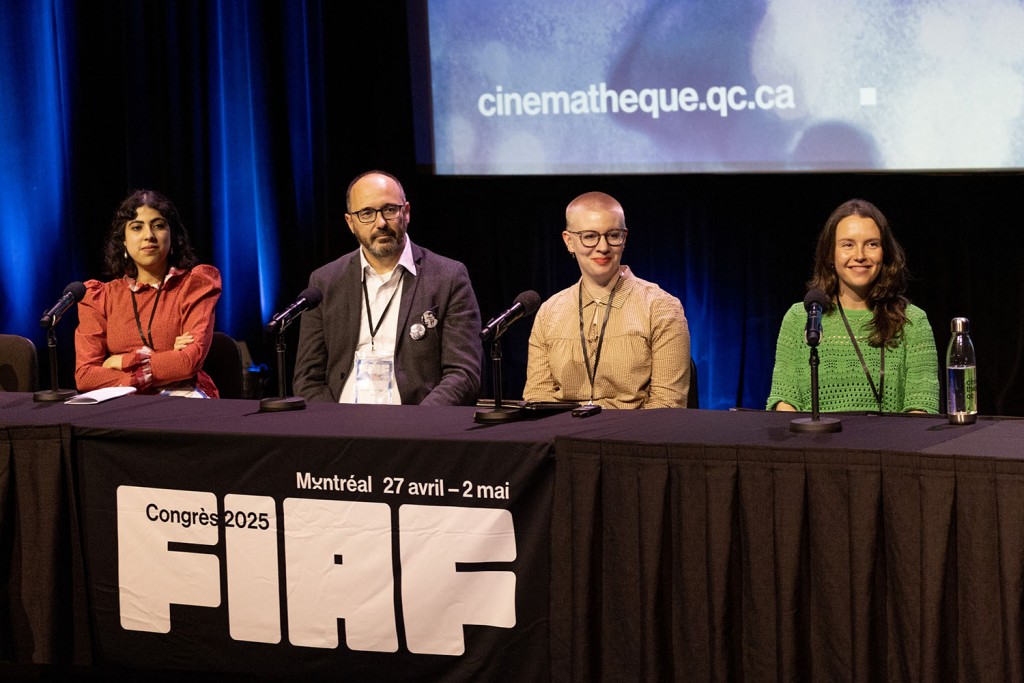
2025 Montreal Symposium
Session 3 - Interventions, Revelations
Montreal, 28 April 2025
Please do not publish or re-use in any way any of these documents without prior permission of the speakers.
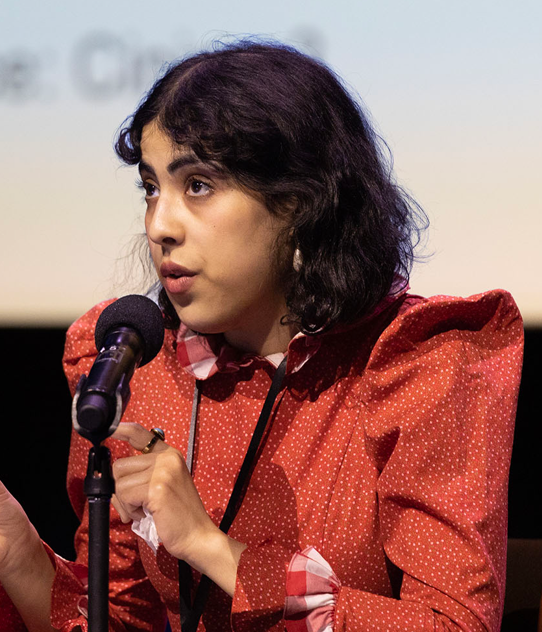
Crossing the Seventh Gate: Archival Re-appropriation and Re-collection in Moroccan Cinema
Bouchra Assou (Dhakira Collective)
As stated by Peter Limbrick, Ali Essafi’s films constitute an intervention in the creation of an archive of Moroccan cinema and culture in the absence of extensive official archives dedicated to that purpose. To explore this idea of revisitations from the past, this presentation looks first at the works of Ahmed Bouanani and his disciple Ali Essafi, two filmmakers whose film practices are characterized by a plurality of form and content. Common to both their works is the use of the archive as a narrative tool. Before the Dying of the Light (2020) and Wanted (2011) by Ali Essafi are cinematographic essays about the 1970s or what is historically dubbed as the “years of lead” in Morocco, an era mired with state-sanctioned censorship and heavy crackdowns on political dissidence and nearly no visual memory. Essafi uses montage to combine archival footage (especially excerpts from landmark Moroccan films of the era by filmmakers such as Derkaoui, Abbazi, Reggab, Bouanani and more) and narration in order to reconstitute the “missing image” by evoking memories of the 1960s and 1970s rather than illustrating the first-hand account of political activism and repression. These films are part of a larger practice that is in direct response to an archive that is characterized as much by absence as by presence. Conversely, Crossing the Seventh Gate (2017) is a portrait of a seminal figure in the history of Moroccan cinema and literature Ahmed Bouanani and equally takes an explicit stand against the state-driven policy of forgetting. Blending excerpts of films by Bouanani and interviews with the filmmaker where he elaborates on his position as a filmmaker/editor and the various censorship and erasure he and his family both faced throughout his career, the film endearingly maps out Bouanani’s independent career.
Film and Reality, ou comment l’un des tout premiers films de compilation a été rendu possible par l’émergence de la FIAF
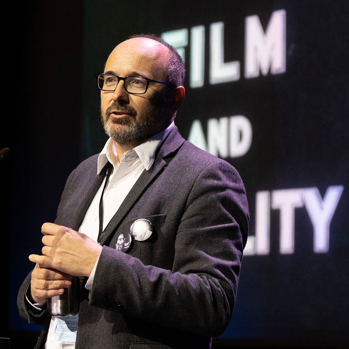
Christophe Dupin (FIAF)
Inaugurated in July 1935, the National Film Library (a Department of the British Film Institute) had from the start the double mission of preserving film heritage – both as an art and as a documentary source – and to promote “film appreciation” in schools and film societies. It is with that double objective in mind that this pioneering film archive (a founding member of FIAF in June 1938) soon began to produce compilation films illustrating various aspects of film history. One of the very first ones (and the most ambitious one), Film and Reality, illustrated the development of documentary film and realism in cinema through 58 extracts dating from the origins of cinema to the 1930s. It was assembled between 1938 and 1942 by the Brazilian documentary filmmaker Alberto Cavalcanti with the assistance of NFL Curator Ernest Lindgren. The film clips were selected not only from the NFL’s own collections but also from those of the other three founding members of FIAF. This is one particularly interesting aspect of this early feature-length composite film’s production – it represented FIAF’s very first collective endeavour, only a few months after the Federation was officially founded. It also triggered the first of many rows between Henri Langlois and Ernest Lindgren. As for the film itself, it was met with critical acclaim and proved popular in Britain’s non-commercial sector upon its release in 1942, and was widely circulated in the expanding FIAF network after the war.
A Feminist Lens: Reframing Collaboration Between Archives and Scholars with the 1973 Women & Film Festival International
Natania Sherman (TIFF Reference Library)
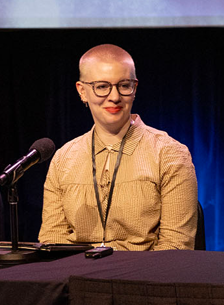
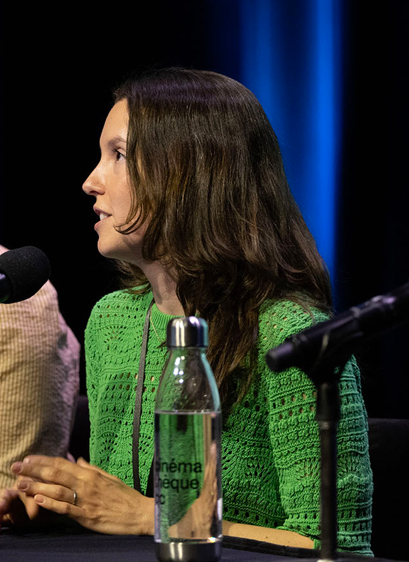
Cléo Sallis-Parchet (York University, Toronto)
Marking 50 years in 2023, the 1973 Women & Film International Festival (WFIF) remains overlooked in Canadian film history. This 10-day festival in Toronto celebrated women in cinema throughout the 20th century including Alice Guy-Blaché, Alanis Obomsawin, Agnès Varda, and more. Subsequently touring the country, it generated a historic network amongst feminist filmmakers across Canada. However, documentation of the WFIF remained privately stored for 50 years. In this presentation, TIFF Reference Library Senior Manager Natania Sherman and film scholar Cléo Sallis-Parchet explore the formation of a new archival collection at TIFF and the rich programming and research opportunities that have resulted from the resurfacing of this collection. Often contained in personal archives, women’s stories remain at risk of loss.
Sallis-Parchet, curator of the collection, reflects on the importance of gathering oral histories and audio-visual records to uncover layers of forgotten histories and the crucial role that archives played in her research. Following this, Sherman explores the collaborative nature of archival work and the benefits of inviting researchers and film scholars into archival spaces to (re)activate archival materials. By working together in moving the WFIF archive from the private to the public domain, Sherman and Sallis-Parchet found opportunities to activate this research through the exhibition "A Feminist Lens: the 1973 Women & Film International Festival" at the TIFF Film Reference Library in 2024-25 and a UNESCO World AV Heritage Day screening of archival materials. As a result, Sallis-Parchet’s research allowed for new audiences to discover the WFIF and nurtured intergenerational relationships between Canadian women filmmakers. This presentation reflects on the generative possibilities between archives and scholars in activating under-researched materials and proposes that archives embrace opportunities to support new scholarly research.





partnership with