
 ©Cinémathèque marocaine
2026 Rabat Symposium
Session 8 - Transferring and Exchanging Knowledge in Film Preservation, Part II
Rabat, 28 April 2026
Please do not publish or re-use in any way any of these documents without prior permission of the speakers.
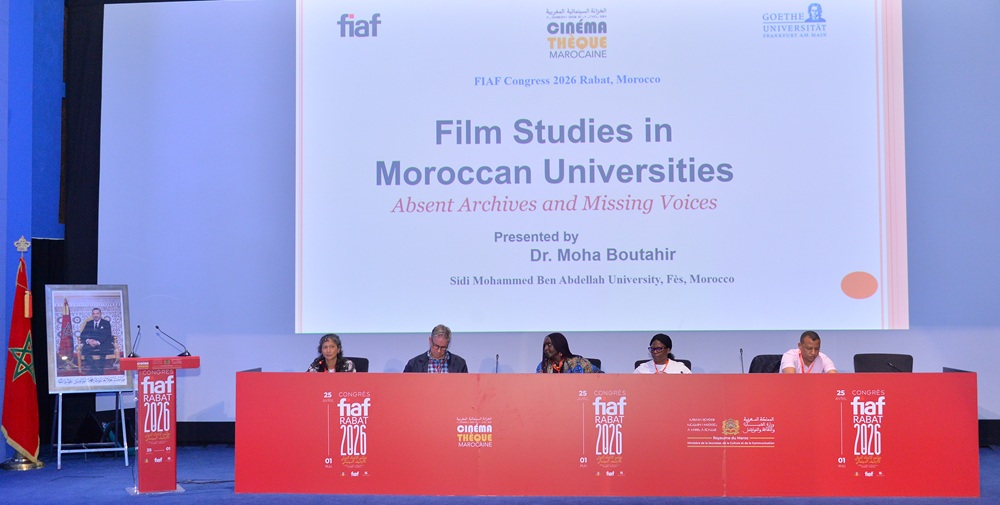
Film studies in Moroccan universities: Absent archives and missing voices
Moha Boutahir (Sidi Mohammed Ben Abdellah University)
Morocco maintains vibrant film production capacity and hosts the Cinémathèque marocaine, yet film studies remains absent as a formal academic discipline in Moroccan universities. This institutional gap creates an epistemological crisis affecting how North African cinema is preserved, theorized, and remembered. Knowledge production remains structured by colonial patterns where Moroccan films are analyzed primarily through Western theoretical frameworks applied by scholars trained in European institutions. This paper examines how establishing film studies programmes would address critical archival and historiographic needs. Cinema industry requires specialists combining preservation skills with theoretical sophistication, yet no Moroccan universities train film archivists, historians, or theorists systematically. Archival work remains custodial rather than generative, lacking the scholarly engagement that transforms preservation into active memory construction. Significantly, substantial cinema research already exists within Moroccan universities - doctoral dissertations and master's theses housed in cultural studies, literary studies, postcolonial studies, and gender studies departments. This dispersed corpus demonstrates scholarly capacity but lacks institutional support for consolidation. Researchers working on overlapping topics from different theoretical perspectives remain isolated, preventing knowledge accumulation and methodological cross-pollination. Film studies establishment would consolidate existing research while creating training pipelines for archival specialists, enabling Morocco to participate as equals in international collaborations rather than relying perpetually on external expertise. The paper proposes concrete pathways: graduate programmes as transitional structures, partnerships between universities and the Cinémathèque, interdisciplinary research centres, and international collaborations designed for capacity-building rather than dependency. By addressing institutional structure alongside archival practice and historiographic methodology, this paper contributes to reimagining African and Arab film memory through sustainable and regionally-rooted models. Film studies in Morocco represents necessary foundation for decolonized cinema scholarship where indigenous voices achieve institutional backing to shape how North African cinema enters historical consciousness.

Knowledge in exchange: Lessons from a transcontinental film heritage partnership
Kudirat Ajoke Ayoola (Nigerian Film Institute)
Vinzenz Hediger (Goethe-Universität Frankfurt)
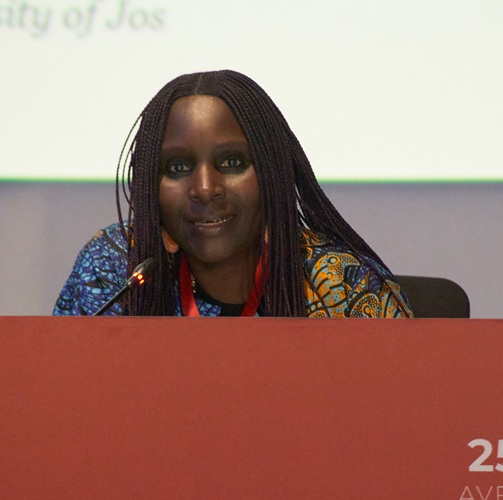
Nancy King (University of Jos)
This paper reports from inside a transcontinental film heritage partnership: the Master of Arts in Film Culture and Archival Studies (MA FCAS), a fully accredited postgraduate programme domiciled in the Department of Theatre and Film Arts at the University of Jos, Nigeria, and delivered in structured cooperation with the Nigerian Film Institute, Goethe-Universität Frankfurt, Arsenal Berlin, and the German Film Museum (DFF), with scholarship support from the Deutscher Akademischer Austauschdienst (DAAD). The programme was initiated in 2016 through the Arsenal-led restoration of Adamu Halilu’s Shaihu Umar (1976) and formally introduced at the University of Jos in 2019. Across five admission streams to date (2019, 2021, 2023, 2024, 2025), the programme has admitted 122 students, registered 117, and graduated 23. DAAD has funded 77 scholarships across two tracks: 23 foreign scholarships, covering a six-month exchange at Goethe-Universität Frankfurt, and 54 local scholarships based in Jos. The presentation argues that the preposition that matters in such a partnership is not transfer but exchange, and that the conditions of genuine exchange are institutional and financial before they are pedagogical. From the vantage point of the host institutions, three propositions are offered: that curriculum is a site of negotiation rather than translation; that infrastructure follows pedagogy in African higher education, not the other way round; and that scholarship is a design choice, not a supplementary act of charity. The presentation relates these propositions to the Symposium’s four headings (methodologies, collaborations, restitutions, and dialogues) and argues that partnerships of this form are a necessary, if not sufficient, condition for the restitution of African film memory to be more than a symbolic gesture.







partnership with