
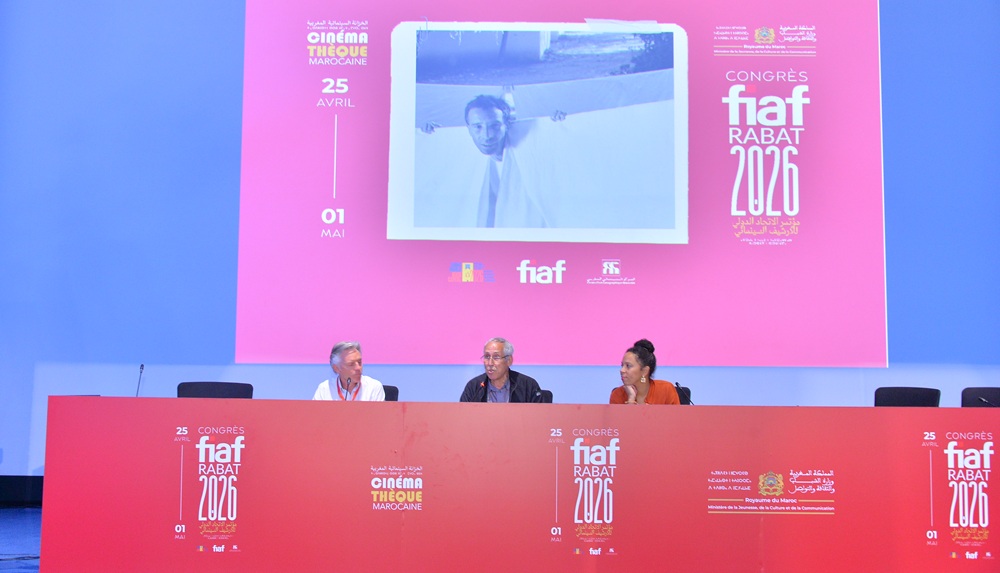
 ©Cinémathèque marocaine
2026 Rabat Symposium
Session 9 - Making Restitution Possible, Part II: Reparation and Dissemination Practices
Rabat, 28 April 2026
Please do not publish or re-use in any way any of these documents without prior permission of the speakers.
Projet de sauvegarde d’un fonds de films palestiniens
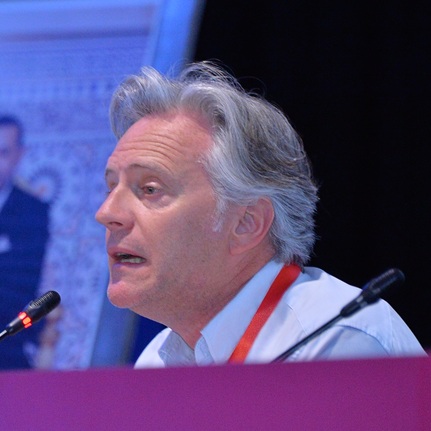
Franck Loiret (Cinémathèque de Toulouse)
Since 2019, the Cinémathèque de Toulouse has been actively working on a project to preserve a collection of Palestinian films dating from the late 1960s to the early 1980s. These are all activist films, propaganda films or newsreels; a large proportion were produced by the Palestinian Cinema Unit (PCU), a collective of filmmakers founded in 1967. The films were housed at the Palestinian Cinema Institute in Beirut, whose entire archive was lost during the Israeli siege of the city in 1982, a grave loss for the collective memory of the Palestinian people.
In the early 2000s, Khadijeh Habashneh – a filmmaker, archivist at the Palestinian Cinema Institute and widow of Mustafa Abu Ali, one of the three founding filmmakers of the PCU – set out to search for the lost films. As the negatives were held in Israeli archives, she managed to gather, from the Palestinian embassies in Amman and Cairo, around fifty copies sourced from a wide network of supporters of the Palestinian cause, totalling 41 titles.
At the request of Khadijeh Habashneh, the Cinémathèque de Toulouse assessed the entire collection in early December 2019. Many reels were in poor condition, and several showed signs of vinegar syndrome. It was therefore necessary to store the films as quickly as possible in a suitable facility. Once diplomatic support had been secured from the French Consulate-General in Jerusalem, the Cinémathèque de Toulouse drew up a temporary deposit agreement with the Palestinian Cultural Fund, undertaking to preserve these archives and return them as soon as suitable on-site storage conditions were in place. The Cinémathèque processed the collection by digitizing the majority of the films to facilitate their consultation and distribution. We have, however, decided not to proceed with their restoration. Indeed, we believe it is essential to leave the history of these copies visible – the signs of wear and tear, the subtitles added in a hurry – without tampering with or embellishing them. The time for restoration will come when the negatives are returned.
There is still much to be done: completing the subtitling, studying the films, screening them whilst providing context, facilitating their reuse, but also attempting to map out these "exiled" archives, in collaboration with other archives.
Réparer le visible : repenser la mémoire cinématographique africaine et les enjeux contemporains de restitution à partir de la Cinémathèque Afrique de l'Institut Français
Farah Clémentine Dramani-Issifou (Independent researcher)
African and Arab cinema forms a major part of the global history of cinema, both in terms of the diversity of its forms and its role in developing critical narratives of post-colonial societies. Yet this heritage remains one of the least accessible, due to historical factors linked to colonization, the asymmetrical circulation of works, and the concentration of copies and rights within Western institutions. A significant proportion of the films by pioneers such as Ousmane Sembène, Sarah Maldoror, Med Hondo and Safi Faye are now held outside the African continent.
The Institut Français’s Cinémathèque Afrique offers a particularly interesting case study in this regard. Founded in 1961, it holds over 1,700 films produced in Africa or about Africa. This collection brings together works that form an integral part of the history of African cinema: liberation struggles, emancipation movements, and social and aesthetic transformations. It constitutes a diasporic cinematic memory, access to which on the continent remains limited.
The book Réparer le visible, La Cinémathèque Afrique: héritages, mémoires et devenirs d’un patrimoine cinématographique entre la France et le continent africain (Institut Français/Marest éditeur, 2026) takes this collection as its starting point to examine contemporary approaches to heritage preservation, transmission and restitution. Its methodology is based on a transcontinental academic and editorial framework bringing together academics, film critics, programmers and distribution professionals from various geographical regions. This diversity of perspectives enables the project to combine historical analysis, a critical reading of the film collections and an understanding of the practical realities of how these works are circulated.
Set against a backdrop marked by the emergence of preservation and digitization initiatives across the African continent, the project examines contemporary issues relating to restitution, cultural rights and accessibility. It regards the diasporic dimension of this heritage as a defining legacy, inviting reflection on a renewed ethic of relationship-building, on reimagined frameworks for heritage and scientific cooperation between film archives, researchers, programmers and the communities concerned, as well as on the development of a shared ecosystem for African film archives and the possible future directions of the Cinémathèque Afrique.






partnership with