 ©Cinémathèque marocaine
2026 Rabat Symposium
Session 12 - Dialogues with Practices
Rabat, 29 April 2026
Please do not publish or re-use in any way any of these documents without prior permission of the speakers.
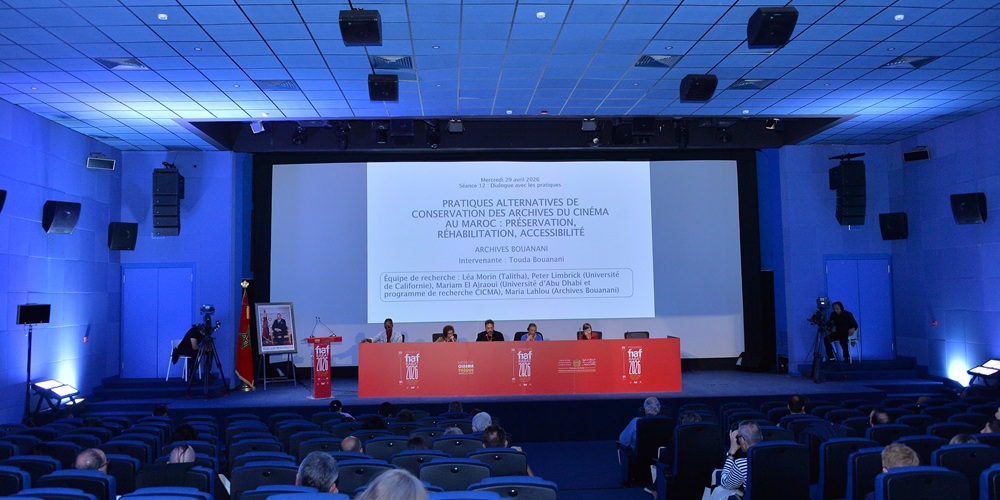
Pratiques alternatives de conservation des archives du cinéma au Maroc: Préservation, réhabilitation, accessibilité
Touda Bouanani (Archives Bouanani)
This presentation focuses on alternative approaches to the preservation of film archives in Morocco. Archives in Morocco – and film archives in particular – face numerous challenges when it comes to preservation. Institutional structures do exist, but they are often ineffective, lack resources or remain limited in terms of accessibility. The Cinémathèque marocaine, for example, has carried out preservation work for many years, but until recently this was not accessible to researchers or the general public.
Against this backdrop, and for the past decade or so, researchers, filmmakers and cultural figures have been examining the issue of Morocco’s film archives and proposing alternatives for their preservation. These initiatives, often isolated but essential, have not only enabled the preservation of film works and documents relating to their production, but also their promotion and made them available to a wider audience.
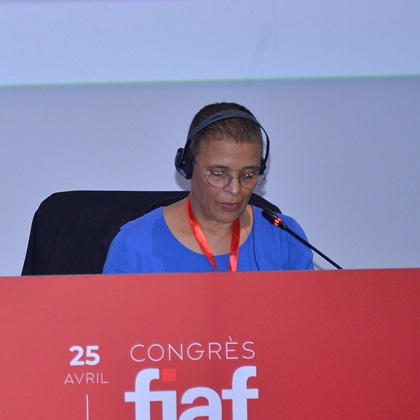
Film programming from the semi-periphery: Archival translation and the mediation of African and Arab political film heritage in Eastern Europe
Klara Trsková (Národní filmový archiv)
This paper explores how film archives located in semi-peripheral Europe can engage with African and Arab militant and decolonial cinema while navigating audiences shaped by political fatigue and historical scepticism toward ideology. Drawing on Frantz Fanon’s understanding of decolonization as a gradual, collective, and affective process—rather than a singular revolutionary event—the paper frames cinema programming as a series of incremental gestures of encounter. Grounded in the speaker's three years of experience programming cinema seasons in a single-screen non-commercial cinema titled Each Film Is a Small Victory (title that paraphrases Fanon’s assertion that “each day is a small victory”) positioning film exhibition as a slow practice of political imagination rather than didactic mobilization. The programming is always shaped by the material conditions of the collection in Národní filmový archiv (NFA) in Prague: each cycle emerges from the film prints physically held in the collection. By working with these existing archival prints, the seasons illuminated the often-overlooked historical trajectories through which African and Arab militant films entered Czechoslovakia: via educational exchanges, festival circulation, and networks of solidarity. This curatorial process functioned not only as public exhibition but also as an archival intervention, contributing to the clarification of the preservation status of the works and reactivating dormant holdings through research, projection, and contextualization.
The paper situates these initiatives within debates on Third Cinema, decolonial aesthetics, and archival activism, arguing that exhibition in post-socialist contexts requires a recalibration of political address. In Eastern Europe, where state-socialist propaganda has produced enduring distrust toward overt political discourse, militant cinema risks being dismissed as ideological or historically distant. In response, the curatorial strategy emphasized affect, form, and historical resonance—foregrounding cinematic language, personal trajectories, and transnational educational exchanges as points of identification. This approach treats programming as a mode of archival translation: a process of mediating meaning, memory, and political urgency across asymmetrical cultural and epistemic frameworks. The paper argues that such translation-oriented curatorial practices can transform national film archives from repositories of heritage into active agents of transnational solidarity. Ultimately, the paper proposes a collaborative archival model grounded in shared historical awareness, ethical circulation, and sustained exchange—where each screening operates as a small, contingent, yet necessary victory in the ongoing struggle over cinematic memory and political imagination.
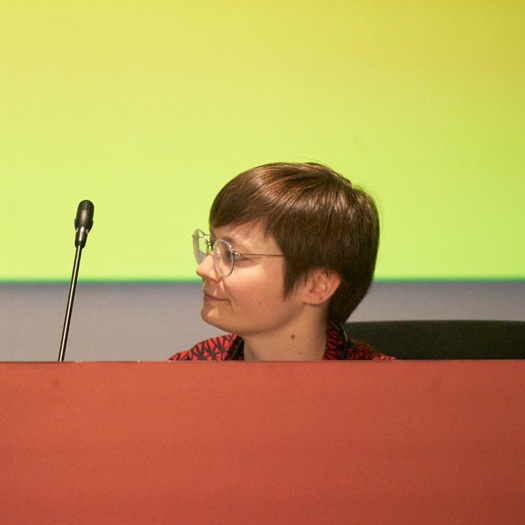
How can an archive of lost films contribute to film history and archival practice?
Didi Cheeka (Lagos Film Society)
The demand for the restitution of Africa's abducted artefacts sequestered in the museums of Europe and America is widening to include calls for restitution of audiovisual materials extracted from the (ex-)colonies—most, if not all, of Africa's audiovisual heritage is held outside Africa in conditions of restricted access and absence of information regarding their status. This fact poses a dilemma for African film scholars wishing to utililize these films for research, to extend insight into film practices and methods of films from an earlier period before the digital era, regarding absence of—and access to—sources to consult for scholarship. Hence, the question: How can an archive of lost films contribute to film history and archival practice? Nigeria’s Celluloid Remains - An Archive of Lost Films is intended as a digital archive of information, including illustrations and reconstructions, of missing films from Nigeria's cinema history.
The archive will serve as an online portal aimed at collecting and documenting film titles which are believed lost or missing. The aim is not to produce definitive information and materials for these films upfront but, rather, to provide a platform of research and exchange where information and materials are dynamically uploaded and updated. This collaborative effort will include lists of films made within the context of colonialism and provide context for their inclusion, by offering the possibility of re-using these images to destroy colonial narratives and reconstruct a new anti-colonial response—in this instance, it will pose the question: are museums and artefacts based frameworks for restitutive justice transferable to audiovisual archives? At the core of this initiative is to resurrect and creatively apply the idea of third cinema to Global South archival practice.
Relinking the chain of memory: A talk on archival use in film and artworks
Jihan El-Tahri (Independent researcher)
For many Arabs and Africans, the remnants of images, oralities, and sounds from the past are urgently needed to reconnect with our heritage. Engaging with the archive is not about looking backwards, but about using past knowledge as a tool to reinterpret our present reality and imagine alternative futures. What was captured, who captured it, and why was that specific moment deemed necessary? The space between official History and Memory forms the groundwork of our political imaginaries, and found footage often supports the dominant narrative over others. How can alternative narratives be eked out of controlled images? Colonial rule led to erasure and assimilation, leaving few traces of who we really or what actually happened. Current debates on Restitution open a gap that calls for research and the reappropriation of silenced images that have been disconnected from their lineage. While archive preservation is now a priority for institutional funders, critical questions remain: how do we access and interrogate local and international collections? How do we challenge inherited representations and fill in the missing frames of silenced histories? Can personal archival collections correct misconceptions? Some answers might lie more in the process of finding the footage and how it is used rather than in the image itself. Institutional archives construct coherent timelines that reinforce dominant narratives; challenging the context and narrative falls to researchers, filmmakers, and artists who play a crucial role in complexifying restitution and gather scattered fragments to reconstruct the spaces in between and relink social and political memory by translating the legacy of the past into today’s vocabulary.





partnership with